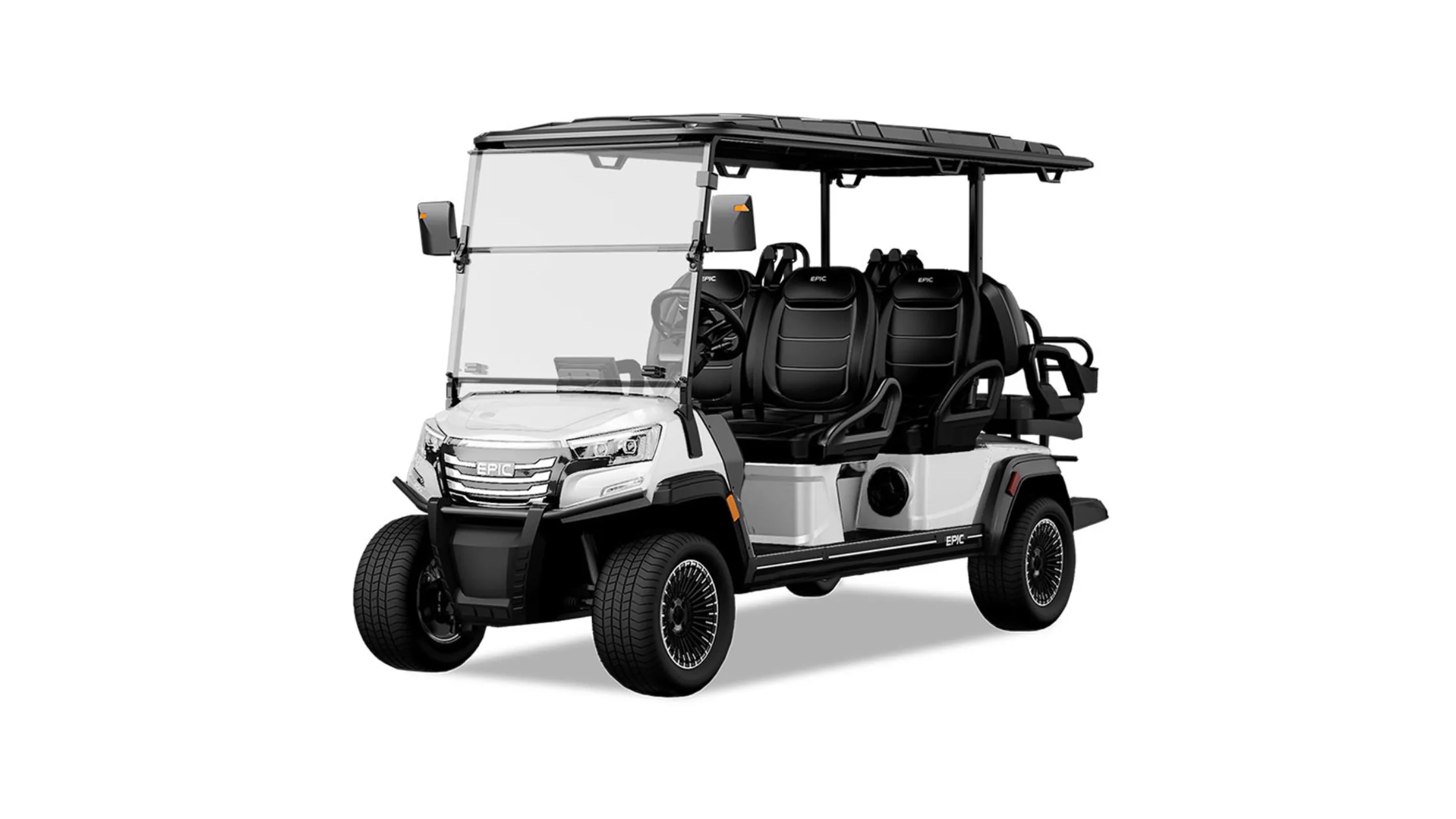
An Epic Golf Cart Dealer provides access to electric carts engineered for recreational transportation, neighborhood mobility, property travel, and low-speed vehicle applications. Epic carts combine compact exterior dimensions with lithium battery technology, AC propulsion, passenger-oriented seating, integrated lighting, and digital controls. The available product range includes configurations designed for two, four, or six occupants, helping buyers match vehicle capacity to daily transportation requirements. Selected models also include equipment associated with low-speed vehicle operation, although registration and public-road eligibility depend on applicable state and local regulations.
Epic Golf Cart Dealer Vehicle Categories
An Epic Golf Cart Dealer can help buyers compare distinct vehicle formats rather than treating every electric cart as functionally identical. Seating layout, body length, rear-seat orientation, cargo flexibility, wheel configuration, and installed road equipment all affect vehicle usability. A compact cart may fit golf-course travel, private property use, or short recreational trips, while a longer model can accommodate families, guests, and community transportation duties. Some configurations emphasize forward-facing passenger seating, while others incorporate rear-facing positions that can support flexible passenger and cargo arrangements.
Compact two-passenger configurations
Compact Epic golf carts provide a practical option for drivers who typically travel alone or with one passenger. Their shorter dimensions can make them easier to maneuver along cart paths, position inside garages, and store in areas with limited depth. A two-passenger layout may also preserve rear space for golf bags, utility equipment, or task-specific accessories, depending on the selected body configuration. This vehicle category retains electric propulsion and modern control technology without adding the length required for multiple passenger rows.
Four-passenger Epic golf carts
Four-passenger Epic golf carts combine useful occupant capacity with exterior dimensions that remain manageable for many residential and recreational environments. The Epic E40FX, for example, uses a four-seat configuration with a 6.3-kW AC motor, a 51-volt lithium battery system, and a 450-amp controller. This platform can support family trips, neighborhood transportation, guest travel, and routine community use without adopting the longer footprint of a six-passenger cart. Rear-seat construction can also influence cargo versatility, particularly when the vehicle includes a convertible platform, removable storage component, or rear trunk arrangement.
Six-passenger configurations
Six-passenger Epic golf carts extend the frame and seating structure to transport a larger group in a single vehicle. This format can serve residential communities, hospitality properties, campuses, event venues, and households that regularly carry several occupants. The added length requires attention to garage depth, turning space, parking dimensions, driveway transitions, and safe passenger entry. A larger passenger load can also affect acceleration, braking distance, steering response, and energy consumption during a trip.
Epic Electric Performance and Charging Technology
Epic golf cart performance depends on the coordinated operation of the battery, motor, controller, charger, gearing, tires, and chassis. Certain FX Series configurations pair a 6.3-kW AC motor with a 51-volt, 105-amp-hour lithium battery and a 450-amp controller. This combination supports controlled power delivery during initial acceleration, steady cruising, repeated stops, and moderate grade changes. Available operating range varies according to speed, passenger weight, cargo, terrain, temperature, tire selection, accessory use, and driving style.
AC motor and electronic controller operation
An AC motor generates the propulsion needed to move the cart, while the electronic controller regulates how electrical energy reaches that motor. Controller programming influences throttle response, low-speed control, acceleration behavior, and the delivery of power under changing loads. Predictable pedal response is especially important in parking areas, community entrances, pedestrian zones, and other environments that require precise movement. Motor output also affects grade capability when the cart carries multiple passengers, cargo, or larger wheel-and-tire combinations.
Lithium battery characteristics
Lithium battery technology creates a different operating and maintenance profile from conventional flooded lead-acid battery packs. A lithium system generally requires no routine watering, reduces the number of separate battery connections, and can provide relatively consistent voltage through much of its usable charge cycle. The 51-volt, 105-amp-hour battery installed in selected Epic carts supplies energy to the drivetrain within a compact battery assembly. An integrated battery management system can monitor voltage, current, temperature, charging, discharge, and cell conditions to support controlled operation.
Onboard charging and route planning
An onboard charger allows the cart to connect to an appropriate electrical supply without requiring the owner to carry a separate charging unit during routine use. A body-mounted charge indicator can provide a convenient view of charging status before the next trip. Drivers should plan routes that remain comfortably within the vehicle’s usable operating range and account for the energy needed to return to the charging location. High speeds, frequent acceleration, heavy passenger loads, larger tires, steep grades, and continuous accessory use can reduce travel distance between charging sessions.
Chassis, Suspension, and Braking Characteristics
The chassis, suspension, steering, brakes, wheels, and tires determine how an Epic cart responds to pavement seams, driveway transitions, turns, and irregular surfaces. Independent front suspension can allow each front wheel to react separately when surface height changes from one side of the vehicle to the other. Larger wheels and street-oriented tires can support stable paved-surface operation, although they may also change steering effort, ride firmness, ground clearance, and energy consumption. Lifted configurations provide a different stance and additional clearance, but they also raise the seating position and vehicle center of gravity.
Independent suspension and steering response
Dual A-arm independent front suspension, used on selected FX Series carts, controls wheel movement through separate upper and lower suspension links. This design can support composed steering and more independent wheel response compared with a basic rigid front arrangement. It does not remove the need to reduce speed before sharp corners, drainage channels, raised crossings, damaged pavement, or loose surfaces. Tire pressure also has a direct effect on steering feel, ride quality, rolling resistance, traction, and battery consumption.
Four-wheel braking systems
Four-wheel disc brakes apply braking force at each wheel and can support controlled deceleration when the cart carries passengers or cargo. Actual stopping performance still depends on road surface, tire condition, vehicle speed, total load, brake temperature, and component condition. Drivers should provide additional stopping distance on wet pavement, loose material, downhill sections, and routes with limited visibility. The parking brake or electronic parking mechanism should remain engaged when occupants enter or leave a stationary cart, particularly on an incline.
Wheels, tires, and ground clearance
Selected Epic FX configurations use 14-inch aluminum wheels paired with street-oriented tires. Street tires suit paved routes and generally produce different steering, ride, and rolling characteristics from aggressive all-terrain tread. All-terrain tires can improve traction on grass, packed soil, or loose surfaces, but they may increase road noise, rolling resistance, steering effort, and electrical consumption. Ground clearance must be evaluated alongside suspension height and tire diameter because larger wheels alone do not make a cart suitable for demanding terrain.
Comfort, Technology, and Safety Equipment
Modern Epic golf carts incorporate comfort and technology features beyond the basic controls found on traditional course carts. Equipment can include a digital display, backup camera, wireless device charging, USB ports, audio components, interior storage, and comprehensive LED lighting, depending on model and configuration. High-back seating and extended roof coverage can support comfort during longer trips, while grab handles and structured entry areas can assist occupants during boarding. Driver controls should remain visible, logically arranged, and easy to operate without creating unnecessary distraction.
Passenger seating and cabin usability
Seat construction affects passenger support, entry access, spacing, posture, and comfort during repeated operation. High-back seats can provide additional upper-body support compared with low-back bench designs, particularly during longer neighborhood or community trips. Three-point seat belts, when installed, restrain occupants across the lap and shoulder, but each passenger must position and use the belt correctly. Rear-facing seats require added attention during acceleration, braking, and turning because occupants face away from the direction of travel.
Displays, cameras, and device connectivity
A central multimedia display can combine vehicle information, entertainment controls, camera imagery, and selected system functions within one interface. A backup camera expands the driver’s view behind the vehicle, but it does not replace mirror checks or direct visual confirmation before reversing. Wireless charging and USB connections can help maintain compatible device power during longer periods of operation. Marine-grade audio components are designed for open-cabin environments, although screens, speakers, connections, and controls still require proper cleaning and protection.
Lighting and low-speed vehicle equipment
A full LED lighting system can include headlights, taillights, brake lights, turn signals, and accent lighting according to the individual cart specification. Road-oriented equipment may also include a horn, mirrors, windshield, reflectors, seat belts, and a vehicle identification number. The presence of this hardware does not independently authorize the cart for use on every public road. Low-speed vehicle regulations may address registration, permitted routes, posted speed limits, driver qualifications, and mandatory safety components.
Epic Golf Cart Ownership Considerations
Selecting an Epic cart involves evaluating more than body color, wheel design, and seating capacity. Charging access, storage conditions, typical route length, service availability, climate exposure, passenger load, and operating surface all influence long-term usability. Buyers should measure their available storage area and include clearance for the charging cable, doors, mirrors, roof structure, and rear seating. Coastal humidity, rainfall, airborne salt, sand, and strong sunlight also make regular cleaning and component inspection important.
Routine inspection and preventive care
Owners should inspect tire pressure, exterior lighting, mirrors, seat belts, steering response, brake operation, and charge level before frequent road use. Battery connections, charger interfaces, and visible electrical cables should remain clean, secure, dry, and free from obvious damage. Cleaning methods must remain appropriate for the cart’s electrical components, upholstery, body panels, display screens, and exposed hardware. Sand, vegetation, salt residue, and standing moisture should not remain trapped around the chassis, battery compartment, suspension, or seating structure.
Storage and charging preparation
A covered storage location can reduce prolonged exposure to rain, ultraviolet light, airborne debris, and environmental contaminants. The charging area should provide suitable ventilation, convenient electrical access, and enough space to route the cable without creating a tripping hazard. Owners should avoid using damaged outlets, incompatible extension equipment, or charging components that do not meet the vehicle manufacturer’s specifications. Long storage periods may require a specific battery charge level, periodic system checks, or other procedures described in the operating instructions.
Matching configuration to intended use
A driver who usually travels with one passenger may benefit from the maneuverability and cargo flexibility of a compact Epic cart. A household carrying children, guests, or recreational equipment may find that a four-passenger model aligns more closely with routine transportation needs. Six-passenger carts can consolidate group travel, but they require additional storage room, wider turning allowances, and careful load management. Road-focused drivers should prioritize compliant safety equipment, predictable braking, street tires, clear visibility, and accessible controls.
Schedule a Test Ride in Largo, FL
Visit Icon Golf Carts in Largo, FL, to compare Epic configurations and examine their seating, controls, storage, lighting, and electric drivetrain features in person. Our team can help you review passenger capacity, charging access, route conditions, storage requirements, and low-speed vehicle equipment. We encourage drivers to sit in several configurations, inspect passenger entry, test the controls, and evaluate visibility from the driver’s seat. Schedule a test ride to compare acceleration, steering response, braking feel, ride quality, and cabin usability under controlled conditions. Contact us to discuss the Epic cart format that best fits your transportation and ownership requirements.
Back to Research Pages