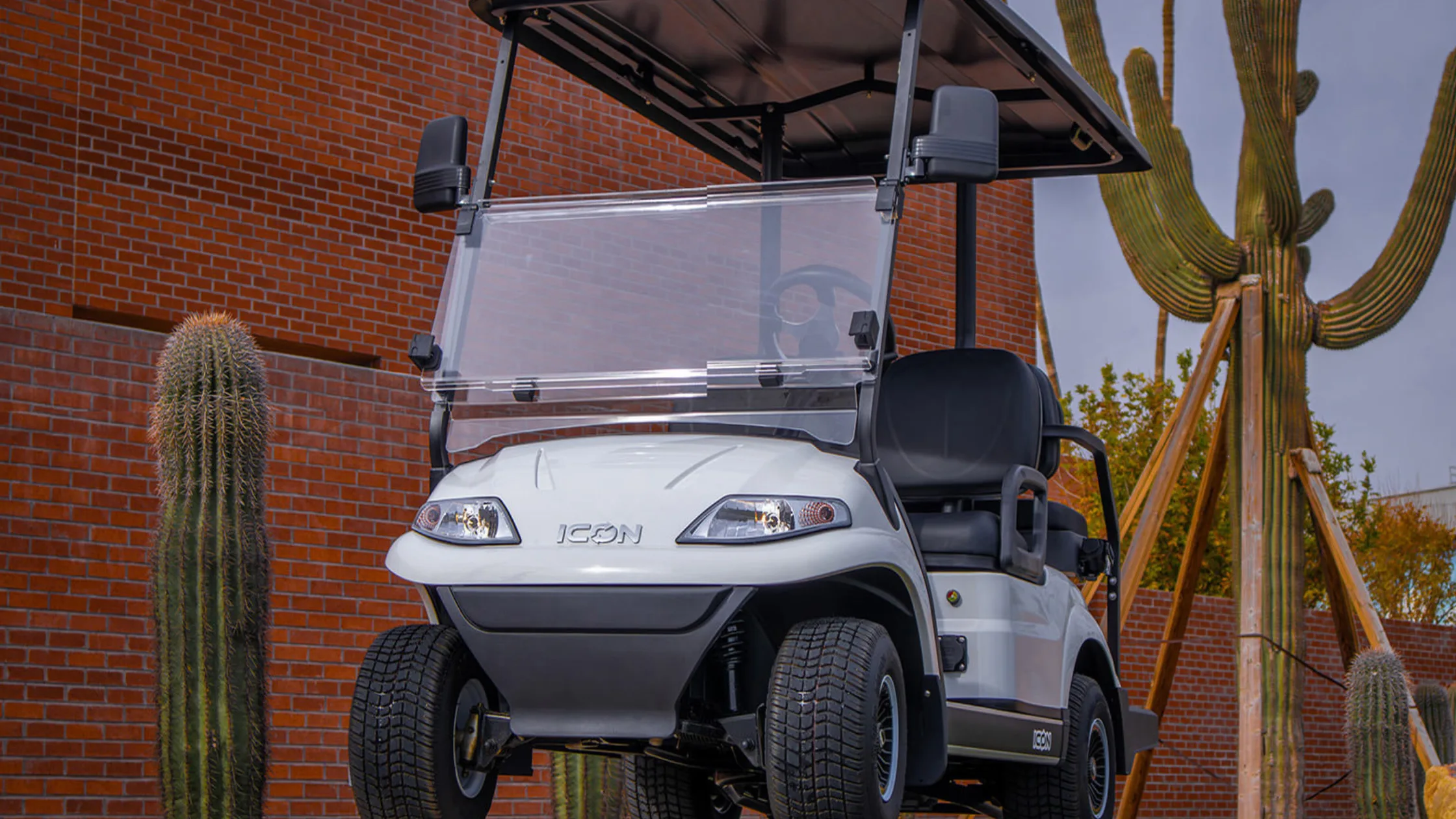
An Icon Golf Cart Dealer provides access to electric vehicles developed for neighborhood transportation, recreational travel, property mobility, and other low-speed applications. Icon Golf Carts combine compact dimensions with electric propulsion, configurable passenger seating, digital controls, lighting systems, and equipment designed for frequent short-distance operation. Available vehicle categories may include standard-height carts, lifted models, four-passenger layouts, six-passenger configurations, and units equipped for potential low-speed vehicle classification. Battery capacity, motor output, controller programming, braking hardware, tire selection, passenger load, and terrain all influence operating performance.
Icon Golf Cart Dealer Vehicle Categories
An Icon Golf Cart Dealer may offer several electric vehicle categories intended for different transportation requirements. Some configurations prioritize compact dimensions and maneuverability, while others provide additional seating, increased ground clearance, or expanded equipment. The appropriate category depends on passenger capacity, surface conditions, storage space, route length, and planned operating environment.
Four-Passenger Golf Cart Configurations
Four-passenger Icon Golf Carts commonly combine a forward-facing front bench with a rear-facing second row. This seating arrangement adds passenger capacity without requiring the longer chassis typically associated with six-passenger designs. A compact wheelbase can support easier maneuvering through residential areas, planned communities, campuses, marinas, and maintained properties. The rear seat may also convert into a small utility platform on compatible configurations, adding flexibility for carrying properly secured items.
Passenger weight affects acceleration, braking distance, steering response, suspension movement, and available driving range. A cart carrying one driver may respond differently when all seats are occupied and additional equipment is loaded. Proper tire pressure becomes especially important because underinflation can increase rolling resistance and alter handling. Suspension condition and brake performance should also be evaluated under the type of load the vehicle will regularly carry.
Six-Passenger Golf Cart Configurations
Six-passenger golf carts use a longer chassis to provide additional seating for families, guests, property personnel, or community transportation. The extended wheelbase creates more occupant space but also changes the vehicle’s turning requirements, parking footprint, and weight distribution. Drivers should account for the added length when navigating tight paths, crowded parking areas, or enclosed storage spaces. A fully occupied six-passenger cart places greater demand on the motor, battery, suspension, tires, and braking system.
Seating orientation may vary across multi-passenger configurations. Some models combine forward-facing rows with a rear-facing bench, while other layouts may prioritize passenger access or cargo adaptability. Grab handles, footrests, seat-belt locations, and entry clearance contribute to occupant usability. Passengers should remain seated with their feet inside the vehicle whenever it is moving.
Standard-Height and Lifted Icon Golf Carts
Standard-height golf carts generally offer a lower step-in point and a lower center of gravity. These characteristics can suit paved neighborhoods, designated cart paths, campuses, and other maintained environments. Lifted carts increase ground clearance and may use larger tires to support travel across uneven or loose surfaces. The additional height can affect steering feel, body movement, passenger entry, garage clearance, and overall stability.
Larger wheels and tires can change effective gearing, acceleration, motor load, braking behavior, and electrical consumption. Aggressive tread patterns may improve traction on certain surfaces, but they can also increase noise and rolling resistance on pavement. Suspension components, wheel offset, tire diameter, and steering geometry should remain compatible. Improperly matched parts may create clearance issues or uneven tire wear.
Electric Powertrain and Charging Technology
Electric propulsion defines the operating character of Icon Golf Carts. The powertrain generally includes a traction battery, electric motor, electronic controller, onboard charging components, high-current cables, and supporting control hardware. These systems work together to determine acceleration, grade response, operating smoothness, energy use, and range between charging sessions. Motor output is an important specification, but battery condition, controller calibration, vehicle weight, tire size, passenger load, and terrain also influence performance.
Lithium Battery Systems
Many modern Icon Golf Carts use lithium battery technology to provide consistent electrical output in a compact package. Lithium batteries generally maintain steadier performance through much of their usable charge than traditional lead-acid battery banks. They also remove the routine electrolyte-level checks associated with flooded lead-acid designs. An integrated battery management system can monitor voltage, current, temperature, and other operating conditions.
Battery capacity influences how much energy the cart can store, but it does not establish a fixed driving range in every situation. Passenger load, route grade, driving speed, tire pressure, accessory use, ambient temperature, and repeated acceleration can change energy consumption. Larger tires and lifted suspension systems may also increase the power required to maintain movement. Drivers planning longer neighborhood routes should consider their typical operating pattern instead of relying only on a general range estimate.
Some battery systems may provide Bluetooth® monitoring through a compatible mobile application. This function can allow an owner to view battery status and selected operating information without opening a battery compartment. Digital monitoring can assist with charging decisions and help identify unusual changes in battery behavior. It does not replace inspection of cables, terminals, mounting hardware, and charging equipment.
AC Motors and Electronic Controllers
Alternating-current motors can provide smooth acceleration and controlled power delivery across a range of low-speed driving conditions. The electronic motor controller regulates current according to accelerator position, vehicle speed, programmed limits, and system demand. Motor output expressed in kilowatts provides one comparison point, but the rating must be considered alongside vehicle weight and controller programming. A higher-output motor does not automatically provide better usability if the battery, tires, brakes, and chassis are poorly matched.
Grade performance depends on battery state, passenger weight, tire diameter, surface traction, route incline, and ambient conditions. Repeated operation on steep terrain can place increased demand on the motor, controller, and battery. Drivers may also notice different acceleration when the cart carries several passengers or heavy cargo. Regenerative braking may assist with speed management on compatible configurations, although operation varies by powertrain design.
Charging Equipment and Electrical Access
A suitable charging location is an important ownership requirement for any electric golf cart. The area should provide a compatible electrical connection and protection from standing water, unnecessary heat, and direct weather exposure. Owners should use charging equipment designed for the installed battery system because voltage and charging profiles must match. Charge cables should remain free from crushing, sharp bends, damaged insulation, and contaminated connectors.
Charging time varies according to battery capacity, remaining state of charge, charger output, temperature, and active electrical loads. Owners should inspect the charge port before connection and follow the correct sequence for the specific vehicle. Accessories should be switched off unless the operating instructions state otherwise. An interrupted charge, unusual heat, warning indicator, or damaged connector should receive attention before the cart returns to regular use.
Road-Use Equipment and Driver Controls
Some Icon Golf Carts can be equipped for low-speed vehicle use, subject to applicable equipment standards, registration procedures, and local operating rules. Vehicle speed alone does not determine legal road status. The completed cart may need specific lighting, occupant restraints, mirrors, identification information, documentation, and other required components. Rules can differ among public roads, golf-cart zones, private communities, campuses, and municipal operating areas.
LSV Equipment and Visibility Systems
Road-oriented equipment may include headlights, taillights, brake lights, turn signals, reflectors, mirrors, a horn, seat belts, and an approved windshield. These components support vehicle visibility, driver communication, rearward awareness, and occupant retention. Full LED lighting can provide clear illumination with relatively low electrical demand. Lamps still require routine checks for damage, moisture intrusion, alignment, and proper operation.
Mirrors should provide useful rearward coverage without creating unnecessary interference during entry or storage. Seat belts should remain accessible, correctly routed, and used by occupants in the seating positions provided. Windshields require regular cleaning to preserve forward visibility, especially after exposure to dust, rain residue, insects, or coastal contaminants. Turn signals and brake lamps should be checked before operation in shared traffic areas.
Low-speed vehicle classification may involve registration, documentation, identification, and other regulatory steps in addition to equipment installation. A cart that appears road-ready may still require administrative approval before public-road operation. Owners should not assume that lighting and seat belts alone establish legal eligibility. Local speed limits, road classifications, crossing rules, and driver requirements may also apply.
Digital Displays and Operating Interfaces
Digital displays may present vehicle speed, battery status, drive selection, lighting indicators, and system information. A clear display allows the driver to monitor key functions without excessive distraction. Touchscreen systems may integrate compatible audio, settings, cameras, or media controls, depending on the selected configuration. Display size is less important than visibility, logical menu structure, and ease of use from the driving position.
Control placement influences daily usability and driver confidence. Direction selectors, parking controls, lighting switches, turn-signal controls, and charging indicators should be easy to identify. Electric motors can respond promptly to accelerator input, so first-time drivers should practice starts, stops, turns, and reversing in a controlled area. Smooth pedal application helps manage passenger comfort and reduces abrupt weight transfer.
Backup Cameras and Rearward Awareness
A backup camera can improve rearward awareness when maneuvering around parked vehicles, landscaping, curbs, or other obstacles. The camera image should supplement mirrors and direct observation rather than replace them. Lens contamination can reduce clarity, especially after exposure to rain, dust, road film, or salt residue. Owners should clean the lens with materials that will not scratch its surface.
Longer six-passenger models may benefit particularly from added rearward visibility because their extended chassis changes the area behind the driver. Rear-facing passengers and cargo can also affect sightlines. Drivers should confirm that occupants, accessories, and stored items do not block mirrors or required lighting. Slow, controlled reversing remains important even when a camera is installed.
Chassis, Comfort, Customization, and Ownership
The chassis connects the powertrain, suspension, steering, brakes, seating, wheels, tires, and body structure. Its dimensions influence passenger space, wheelbase, turning radius, ride quality, and overall stability. Comfort depends on seating geometry, suspension movement, tire construction, vehicle height, and operating surface. Custom equipment can adapt a cart for specific transportation needs, but every addition should remain compatible with the electrical and mechanical systems.
Suspension, Steering, and Braking
Suspension components manage wheel movement and help maintain tire contact across changing surfaces. Springs and dampers must account for vehicle weight, passenger load, chassis length, and intended terrain. A six-passenger or lifted cart may require different suspension characteristics than a compact standard-height model. Steering should remain predictable without excessive free play, pulling, or vibration.
Braking systems should provide progressive response and consistent stopping performance at the vehicle’s intended operating speeds. Passenger weight and route grade can increase the distance required to stop. Drivers should leave additional space when the cart is fully occupied or traveling on wet surfaces. Brake noise, pedal changes, pulling, or reduced stopping performance should receive prompt attention.
Tire and Wheel Selection
Tires directly influence traction, ride comfort, steering effort, operating noise, and electrical efficiency. Street-oriented tread patterns generally suit paved neighborhoods and maintained paths. All-terrain tires may provide additional grip on loose or uneven surfaces, but they can increase rolling resistance on pavement. Tire diameter, width, load capacity, and wheel offset must remain compatible with the cart.
Proper inflation supports predictable handling and more even tread wear. Underinflation can increase heat, rolling resistance, and energy consumption, while overinflation may reduce ride compliance. Owners should inspect tires for cuts, cracking, embedded objects, and irregular wear. Alignment should be checked after suspension modifications or when the tread begins wearing unevenly.
Seating and Accessory Integration
Seat design affects posture, support, passenger spacing, and ease of entry. Upholstery materials should be evaluated for durability, cleanability, and resistance to frequent exposure. Rear seating may provide passenger capacity or convert into a cargo platform on compatible models. Any load placed on a utility surface should remain within the vehicle’s limits and be secured before movement.
Accessory options may include marine-grade audio, upgraded displays, additional lighting, storage components, protective enclosures, and wheel packages. Added electrical equipment should be evaluated against battery capacity, converter output, wiring protection, and expected operating time. Exterior lights must not interfere with required road-use lamps or create distracting glare. Audio equipment should be installed with protected connections and secure mounting.
Routine Golf Cart Maintenance
Electric golf carts require less fluid-related attention than combustion-powered vehicles, but they still need systematic maintenance. Service may include checks of battery connections, charging performance, controller operation, high-current cables, brakes, steering, suspension, tires, lighting, and accessory wiring. Diagnostic testing can help isolate an electrical fault before components are replaced. Lithium conversions require compatible batteries, chargers, cables, mounting hardware, controllers, and system settings. A conversion should be treated as a coordinated electrical change rather than a basic battery exchange.
Owners can support reliable operation by monitoring changes in performance. Reduced range, slower acceleration, unusual heat, charging interruptions, warning indicators, steering looseness, vibration, or brake noise should not be ignored. Cleaning procedures should avoid directing high-pressure water into connectors, displays, switches, or charging components. Coastal conditions can increase exposure to moisture, salt, heat, and airborne debris, making regular inspection especially useful.
Storage and Periods of Inactivity
A protected storage location can reduce exposure to standing water, direct sunlight, weather, and unnecessary heat. The parking area should provide enough clearance for the roof, windshield, mirrors, and any lifted suspension or accessory equipment. The vehicle should be secured against unintended movement and stored according to the battery system’s instructions. Electrical accessories should be switched off to prevent unnecessary draw during periods of inactivity.
Before returning a stored cart to service, the owner should inspect tire pressure, lighting, brakes, steering, accelerator response, mirrors, cameras, and displays. Visible cables and connectors should be checked for damage, contamination, or corrosion. The storage area should also be inspected for moisture, debris, and pest activity. A short controlled drive can confirm a normal response before passengers are carried.
Schedule a Test Ride Today
Visit Icon Golf Carts in Largo, FL, to compare electric vehicle categories, seating layouts, lithium battery systems, powertrain configurations, road-use equipment, and customization options. We can help you evaluate how passenger capacity, chassis height, motor output, suspension design, tire selection, and charging access relate to your intended use. Our team can also guide you through the operating controls and arrange a test drive so you can assess comfort, visibility, steering response, acceleration, and braking. Bring information about your typical routes, passenger requirements, storage space, charging location, and primary driving surfaces to support a focused comparison. Contact us to inquire about current availability or schedule a visit.
Back to Research Pages